Fog-triggered multi-vehicle pileup and rescue
Jacob's LadderThe fog-triggered multi-vehicle pileup and rescue turns a sudden collision into a test of whether Yasha can keep faith with his brother while his own body and surroundings feel unreal. Danilo is pinned inside the wrecked car, and Yasha stays with him as further headlights approach, emergency responders arrive, and the firefighters work to free him. The scene’s decisive action is not an escape but a refusal to leave: Yasha chooses his brother’s side even when the wreck itself makes staying dangerous.
Causes and the First Collision
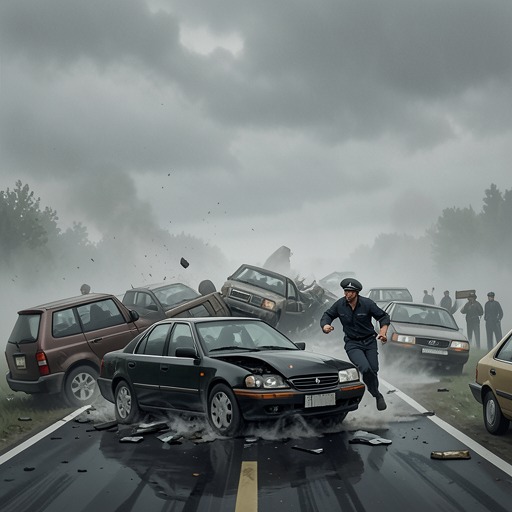
The sequence begins with a warning that does not yet convey the scale of the danger. Static interrupts the car’s reception, and Dan attributes it to the vehicle’s HID retrofit lights. A moment later, the Lexus slams into a vehicle Yasha had not seen in the fog. Air bags deploy in a burst of fabric and gas, and the impact throws the occupants against their seat belts. The abrupt shift from an ordinary drive to a crash leaves little time to understand what has happened before the danger continues.
Yasha then notices another car coming directly toward their side of the vehicle, its headlights faint in the mist. Dan tells him to keep his seat belt on; Yasha instead insists that they need to get out. Dan answers that there is no time. This exchange establishes the immediate conflict between Yasha’s impulse to act and the limited options imposed by the crash. The fog does not merely obscure the road behind them: it makes each approaching vehicle a threat that becomes visible only at close range.
Danilo Trapped and Yasha’s Decision
After the collision, the smell of gasoline, antifreeze, and brake fluid makes the damaged scene legible to Yasha. He understands that Danilo is unconscious and has taken the second car’s impact on his side. Yasha’s hand feels strange and outside his control, yet he manages to release his seat belt. His body is present in the wreck, but his sense of agency and sensation has become unreliable; he describes feeling so little that he might be a corpse walking around.
Even in that state, Yasha turns back toward Danilo and says he needs to get his brother out. The effort is not straightforward: Danilo tells him that his arm is wedged and trapped. He explains that the cars behind them will absorb the impact of any further vehicles, accordioning around the car and protecting him until help arrives. The explanation gives Yasha a reason to move to the side of the road, but he refuses. His answer is categorical: he is not going anywhere. Danilo calls him stubborn and tries to reassure him, but Yasha’s refusal is less an argument about the mechanics of rescue than a commitment not to leave his brother alone in the wreck.
Danilo nevertheless tells Yasha to go and direct the EMTs when they arrive, because he thinks his brother will need to be cut out of the car. The instruction makes the danger and practical need for help explicit, while also turning Yasha’s possible departure into a proposed task rather than abandonment. Yasha does not take that route. He stays as the car horn sounds intermittently, apparently triggered by the disabled vehicle, and headlights emerge again through the fog. The wreck is already crushed between two vehicles, and Yasha recognizes that there are no more air bags to deploy if another car reaches them.
Waiting for Rescue
The wait prolongs the tension between impending danger and helplessness. Yasha hears the rumble of a fire engine and feels hope return. He tries to tell Danilo that emergency services have arrived, but Danilo’s mouth is unresponsive. Yasha then bangs on the window to make the car’s location unmistakable and calls out that his brother is pinned and going into shock. His appeal directs attention both to the immediate rescue problem and to Danilo’s deteriorating condition.
Cam appears outside Yasha’s door in firefighter’s gear and pulls the door open. His arrival links the rescue to a familiar person, but it does not end Yasha’s fear or place Danilo immediately in safety. When Yasha asks whether Danilo is all right, he learns that Cam is taking care of him and that his arm remains pinned. Another responder takes Yasha’s arm and leads him toward a tarp, explaining that triage requires attending to people according to their needs and that ambulances are on the way. Yasha is therefore moved from the wreck even as Danilo remains trapped; the scene presents rescue as an organized process in which care for one person cannot mean abandoning everyone else.
Extraction and Aftermath
While Yasha waits among the people on the tarp, he watches the responders and holds on to the occasional cautious smile from the person caring for them. Those small exchanges serve as an anchor from one moment to the next, a human point of continuity amid shock and disorientation. Eventually, Cam and two other firefighters bring Danilo toward the group on a backboard. The extraction confirms that Danilo has been freed from the car, but the narration does not treat that moment as an instant return to normal: after he is removed, everything blurs and Yasha struggles to keep up.
Yasha eventually ends up in an EMS rig with Danilo, rather than in JT’s vehicle, because Danilo needs to reach the hospital quickly. At the hospital, Yasha establishes himself as Danilo’s brother. The sequence thus carries the bond expressed in his refusal to leave into the aftermath: once the rescue has changed the immediate danger, he remains present as family while his brother is taken for urgent care. The event moves from the obscured threat of the road, through a period when Yasha can do little but stay and call for help, to the concrete relief of Danilo’s extraction and transport.